


 Author:Valentin Estevez, Ph.D.
Higher education institutions have not escaped the monumental demographic, economic, and technological developments shaping today’s economy. These changes have prompted big changes in this industry, as the type and delivery mode of educational services adapt to meet current and future demand. While all these momentous shifts are happening, higher education institutions have also faced increased outside scrutiny of their operations. Government agencies’ inquiries and private litigation have added new items to these institutions’ task lists. These inquiries can be lengthy and time-consuming, putting added strain on already overstretched personnel. Of all the possible steps that could be taken to anticipate or quickly address third-party inquiries, conducting regular assessments of compliance with all relevant regulations and requirements is at the top of the list of cost-effective approaches.
This entry focuses on two topics impacting higher education institutions that have received considerable third-party interest in the past few years: faculty compensation and admission decisions. While these complex topics deserve much more space than is feasible in a blog entry, the goal is to isolate the key themes in each of these topics and provide best practices to assess compliance and ensure that your institution is ready to respond to outside inquiries.
Assessing Faculty Compensation Goes Beyond Ranks and Time in Role
The first step when assessing compensation decisions consists of identifying individuals whose outcomes could be compared because they possess similar skills and perform similar tasks with similar levels of responsibility. While it sounds simple, this is often the most challenging step in a compensation study because HR databases rarely, if ever, contain enough information to make such a determination without reservations. While HR data fields labeled job title, role, or position might appear to fit the bill, a diligent analyst quickly finds that these fields are too broad or too narrow or may miss critical task or responsibility level differences relevant for the analyses at hand. In many cases, the analyst finds that individuals had discretion in naming their roles, causing the analyst to question the usefulness of the data field.
However, when it comes to faculty compensation, third parties often act as if the relatively few and standardized faculty ranks in higher education institutions in the US[1] – Lecturer, Instructor, Assistant, Associate, Professor – allow them to bypass the issue of identifying comparison groups. Third-party inquiries commonly start with the premise that all faculty of a given rank are comparable, alleging that adjustments for time in rank, teaching load, or part-time status are enough to ensure apples-to-apples comparisons. The justification behind this assumption is that faculty in the same rank share common duties, such as teaching, advising students, conducting research, assisting in their department operations, etc. By attempting to reduce the complexity of faculty roles to a few discrete tasks plus a count of years in rank, third parties attempt to assume away the wide range of individualized circumstances impacting faculty compensation, such as:
- Compensation Potential Varies by Field of Study: As discussed above, higher education institutions operate in large labor markets, with top institutions competing for talent with other higher education institutions and other types of private and public employers worldwide. While two faculty members of the same rank may also have the same years in rank and similar teaching evaluations, their field of study or department has a large impact on their compensation. The figure below shows the wide dispersion in median earnings between fields of study, dispersion that also impacts faculty compensation.
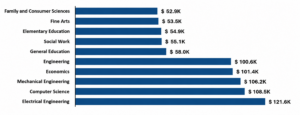
Figure 1. Median Annual Earnings for Field of Bachelor’s Degree for First Major (Source: U.S. Census Bureau, 2022 American Community Survey, 1-year estimates)
- Scholarly Output Measurements Vary by Field of Study: Just like compensation potential, fields of study differ in their evaluation of productivity. Publishing in top academic journals is key in some areas, while book publishing and extension work are a must in others. Even when agreement exists as to the relevant metrics, quality or impact data may be scarce or missing altogether from HR databases.
- Professional Schools May Compensate Faculty Differently: Professional schools, such as law schools and business schools, could recruit from the same labor markets as other departments. Despite this, professional school compensation could substantially differ from that in other departments, given their different academic services. For example, the starting salary for an Assistant Professor in Economics at one of the top US universities ranges from $190,000 in the Economics Department[2] to $260,000 in the Business School.[3]
- Mixed Appointments and Service to the Institution: Further confirming the complexity of faculty compensation, it is not uncommon to observe that faculty in the same department and rank have different workload expectations. For example, in medical schools, faculty could have different time splits concerning teaching, research, mentoring, and clinic work. Service to the institution or department as part of the leadership team also impacts compensation.
- Lateral Hires: Competition for talent is fierce among higher education institutions, and those with proven or promising scholarly output are constantly approached by rival institutions. In HR databases, however, lateral hires could appear with fewer years at the institution and the same or higher compensation than others in the rank.
The situations discussed above are nowhere near an exhaustive list of possible circumstances that could explain a compensation difference between two otherwise identical faculty members in terms of rank and years with the institution. However, without robust and complete data, unexplained differences may appear in third-party reviews. Because of the idiosyncratic and field-specific nature of these circumstances, a best practice when it comes to faculty compensation management consists of periodic proactive compensation reviews. Conducted under legal guidance, this type of study helps identify blind spots and data and documentation gaps before a third-party inquiry arrives.
With the Increased Scrutiny of Admissions Data, Valuable and Experienced Assistance May Be Closer than You Think
Third-party inquiries concerning the demographic composition of admitted students are at historical highs, with several government and private-plaintiff-driven lawsuits featured prominently in the news. These lawsuits have in common allegations that admissions decisions are influenced by the demographic characteristics of the applicants. Admission spots to reputable undergraduate, graduate, or professional school programs are scarce, with many programs facing hundreds or thousands of candidates for every available spot. The value of admission to a top program is reflected in the growth and size of the tutoring and college counseling market.[4] Candidates go to great lengths to improve their acceptance chances.
Admissions involve evaluating an ever-growing number of qualified candidates who possess a wide range of interests and qualifications in order to select those likely to accept admission and, ultimately, thrive in their chosen field of study at the institution. Not surprisingly, the admissions process is extremely complex, with both qualitative and quantitative factors being important in identifying talent and predicting academic success. As an example, a recent study found that while high school GPA and SAT scores, two of the most commonly discussed measures of college-readiness, help predict students’ college GPA, more than half of the variance in college GPA outcomes is unaccounted for.[5] Those quantitative and qualitative factors observed and evaluated by admissions professionals could help close this gap.
Despite the complexity of the admissions process, most of the recent claims of bias in admissions involve comparisons of test scores among admitted students. Comparisons among admitted students could be misleading and, at a minimum, require substantial further study:
- How about the comparison group? Comparisons made among admitted students do not address the question of whether some applicants were allegedly disadvantaged by not being selected. Without information on the non-admitted group’s test scores, GPAs, and any other qualitative or quantitative factors relevant to the admission decisions, many assumptions need to be made in order to make inferences about the admissions process.
- How about factors other than test scores? Reducing admissions to a comparison of test scores is a gross oversimplification of the process. Different fields of study may require different skills than those measured by test scores. Admissions professionals look at a wide array of factors when evaluating the fit of every candidate. That test scores are quantitative and easily available does not make them the only factor when evaluating admissions, especially since most of the variation in college performance is explained by other, likely idiosyncratic, factors.
- How about the performance of the admitted group? Admission bias allegations based solely on test scores imply that no other factors, quantitative or qualitative, could explain the observed decisions. Those other factors ignored by the admission bias allegations could be as predictive as test scores with respect to post-admission performance and help explain the observed admission rate differences.
As with the initial discussion on faculty compensation, the items above concerning admissions are not an exhaustive list of all the relevant factors and comparisons that could shed light on admissions bias allegations. Robust data and well-designed analyses that mimic the admissions process are needed to evaluate these decisions. The knowledge and experience that admissions professionals need to undertake these assessments is likely readily available by reaching out to colleagues from a couple of doors or buildings over in the HR department. Many HR professionals in higher education institutions have extensive experience evaluating and monitoring the institution’s hiring processes, including responding to third-party inquiries. Like admissions, selecting among applicants for a job opening involves evaluating quantitative and qualitative metrics and documenting the steps followed and information considered in arriving at the selections. Many of the lessons learned and best practices that those colleagues in HR possess related to hiring translate well to the evaluation of the admissions process, including efficient and comprehensive data collection and studying the relevance or validity of quantitative and qualitative factors impacting selections. While the road ahead might seem daunting, many open questions concerning admissions could be addressed using familiar approaches and best practices that higher education institutions are already familiar with.
Takeaways: Combine Robust Data and Documentation with Regular Monitoring
As noted in previous entries in this blog and in many NILG-sponsored webinars and events, proactive evaluations of decisions at your institution are the best way to ensure prompt and comprehensive responses to third-party inquiries. HR and admissions decisions are extremely complex, and the legal environment is constantly changing, so engage counsel early and often to ensure that your efforts are directed at the right areas in the right way. Techniques exist that help evaluate your processes if the right documentation and data are in place. Start early, as these studies may uncover blind spots and data gaps that may require remediation. The most common action items after proactive reviews are remedial steps concerning process documentation and data gathering. It is better to face these issues on your timeline rather than on one dictated by a third party. Facing and resolving these issues early will allow for more efficient processes at your institution, which benefits everyone. The ability to respond to third-party inquiries promptly and thoroughly is just the icing on the cake.
[1] National Center for Education Statistics. Digest of Education Statistics. https://nces.ed.gov/programs/digest/d23/tables/dt23_316.10.asp
[2] https://apply.interfolio.com/193682
[3] https://apply.interfolio.com/191225
[4] https://www.forbes.com/sites/rodberger/2022/05/23/democratizing-the-college-admissions-process-is-big-business/
[5] Friedman, John N. et al. Standardized Test Scores and Academic Performance at Ivy-Plus Colleges. NBER Working Paper 33570. https://www.nber.org/papers/w33570